
Food Industry Metal Detectors: Principles Of Operation And Key Components

Sensitivity, calibration, inspection, hygiene, maintenance and selection considerations for food industry metal detectors
Rejection mechanisms and their interaction with detectors are selected according to product type and line layout. Common reject devices include pneumatic air-blasts for discrete items, mechanical pushers or flaps for small packages, and diverter gates or hold-and-inspect pockets for continuous flows. Reject timing must be coordinated with conveyor speed and detection latency to ensure the contaminated item is diverted reliably without damaging product. For pipelines, sanitary valves or bypass arrangements may be used to isolate and remove suspect material while minimising process disruption.
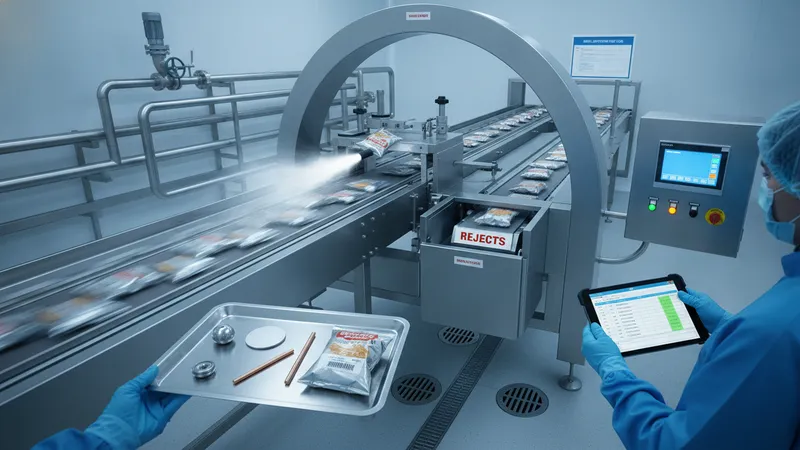
Inspection and testing protocols often use calibrated test pieces and defined frequencies for verification. Test pieces reflect different metal types and shapes to approximate likely contaminants; records of test results may be kept for traceability and quality assurance. The frequency of testing can vary depending on regulatory context and internal risk assessments, but many operations implement routine checks at shifts or at defined production intervals. Test procedures normally emphasise safety and hygiene, ensuring test pieces are tracked and removed from the food stream after use.
Calibration and maintenance are presented as ongoing controls rather than one-time fixes. Calibration may include adjusting detection thresholds, rebalancing coils following mechanical servicing, and validating firmware or software parameter settings. Maintenance tasks typically cover cleaning of detection apertures, inspection of cabling and grounding, lubrication or replacement of reject actuators, and software backups. Planned preventive maintenance schedules are commonly integrated with production planning to reduce unplanned downtime and to maintain consistent detection performance over time.
Selection considerations for a detector system may involve aperture size, frequency capability, hygienic design, integration with line controls and the expected contaminant profile. Aperture dimension affects both accommodation of the product and achievable sensitivity; multi-frequency systems may be preferable where a mix of metal types is a concern. Hygienic design features and sanitation compatibility are often important in food settings. Users commonly assess detector performance using representative trial runs under production conditions and document the outcomes to support ongoing operational controls rather than relying solely on factory specifications.