
Healthcare Data Analytics: Understanding Methods, Tools, And Use Cases

Predictive Analytics and Decision Support Methods in Healthcare Data Analytics
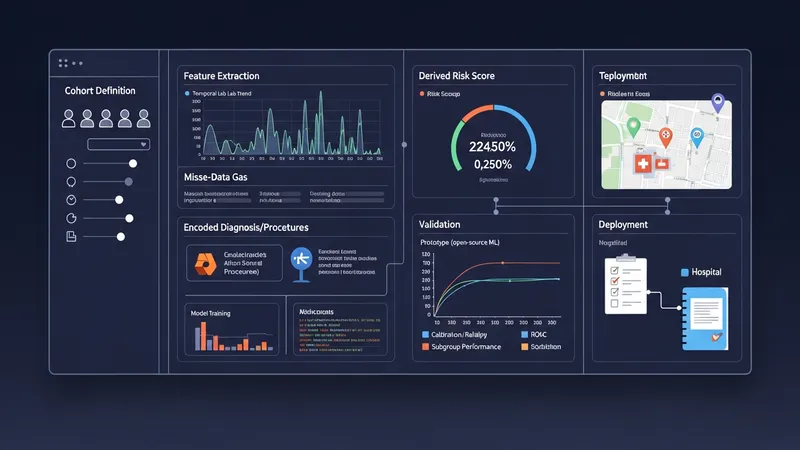
Predictive analytics pipelines usually start with cohort definition and feature extraction, followed by model training, validation, and deployment. Libraries such as scikit-learn are commonly used for prototyping due to their range of algorithms and validation utilities. Model evaluation often emphasizes not only discrimination metrics but also calibration and subgroup performance to detect differential behavior across populations. Documentation of feature derivation and model assumptions is typically part of responsible deployment practices.
Feature engineering in healthcare may include temporal aggregations (lab trends), derived risk scores, and encoding of diagnosis or procedure histories. Handling missing data and censoring often requires domain-aware strategies, and teams typically test multiple imputation or indicator approaches to assess sensitivity. External validation on separate sites or time periods is often recommended to understand generalizability and potential degradation when models face new patient mixes.
When models are integrated into decision-support workflows, attention to user interface and clinical workflow fit is common. Decision-support outputs may present risk scores alongside contextual data and suggested next steps; however, systems typically include disclaimers on limitations and require human review for clinical decisions. Monitoring of model performance post-deployment is often implemented through periodic revalidation and drift detection to identify changes in predictive behavior over time.
Ethical and fairness considerations frequently accompany predictive analytics. Teams may assess potential biases introduced by historical practices or differential data coverage and may report subgroup analyses to stakeholders. Transparency, reproducibility, and stakeholder engagement are often cited as key practices to mitigate unintended consequences when deploying predictive tools within care settings.