
Heating Element Manufacturers: Key Production Processes And Industry Standards

Material Selection and Design Considerations for Heating Element Production
Choosing conductive and sheath materials is a foundational decision affecting performance, cost, and durability. Resistance alloys such as nickel-chromium (nichrome) and iron-chromium-aluminium (FeCrAl) may be used where stable resistivity over temperature is required, while copper-based conductors can be chosen for lower-temperature, high-conductivity needs. Sheath choices—stainless steel, Incoloy, or copper—are influenced by corrosion potential, required heat transfer, and mechanical protection. Designers may apply conservative watt densities when operating environments include oxidation, scale formation, or abrasive contact, and they often model thermal expansion to prevent internal stress and degradation over repeated cycles.
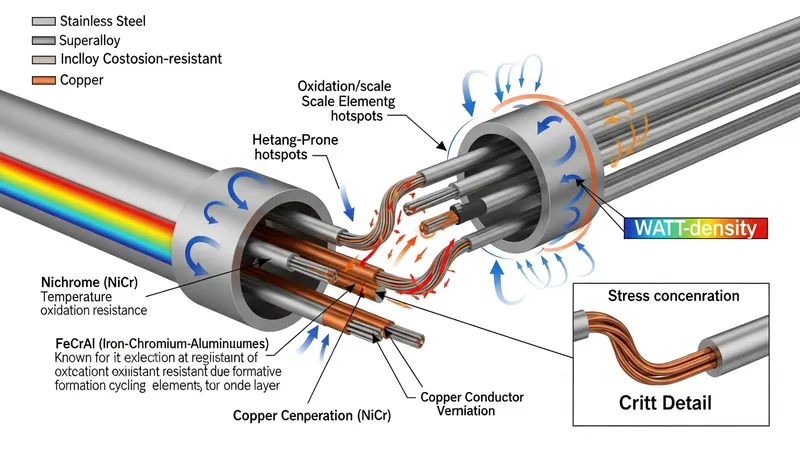
Geometric design factors include element diameter, length-to-diameter ratio, and the presence of bends or terminations that can concentrate stress. Watt density, defined as power per unit surface area, typically guides allowable loading; higher watt densities may reduce element life unless compensated by improved cooling or materials with higher oxidation resistance. Electrical considerations such as lead routing, contact resistance at terminals, and grounding provisions are weighed alongside mechanical fixtures. Tolerances for resistance and physical dimensions are often specified based on application sensitivity and measurement capability during production.
Environmental and regulatory contexts further affect material choices and designs. Exposure to moisture, corrosive chemicals, or salt spray may prompt selection of higher-grade alloys or protective coatings. In food-contact or medical-adjacent applications, material declarations and compliance with hygienic design principles can shape surface finish and sealing methods. Manufacturers often document material certificates and construction drawings so that changes in raw-material suppliers do not unintentionally alter element properties during production runs.
An operational consideration that manufacturers frequently report internally is the trade-off between manufacturability and performance margins. Simpler geometries and standard sizes can reduce lead times and variability, while custom shapes may require prototyping and additional process controls. When specifying elements, engineers may request small pilot runs to validate thermal behavior and assembly compatibility. These practices may help align design intent with reproducible manufacturing outcomes without assuming a single universal solution for all applications.