
Sage Accounts Payable Automation: Understanding Key Features And Workflow Capabilities

Approval workflows and exception handling in accounts payable automation
Approval workflows in automated environments are commonly rule-driven and may include conditional steps based on invoice attributes such as amount, vendor, or cost center. Role-based routing assigns approval tasks to specific users or groups, which can reduce ambiguity about responsibility. Workflow features often include delegation, where an approver may temporarily assign tasks, and escalation, where overdue approvals move to alternate approvers. Audit logs capture each action to support traceability and compliance reviews.
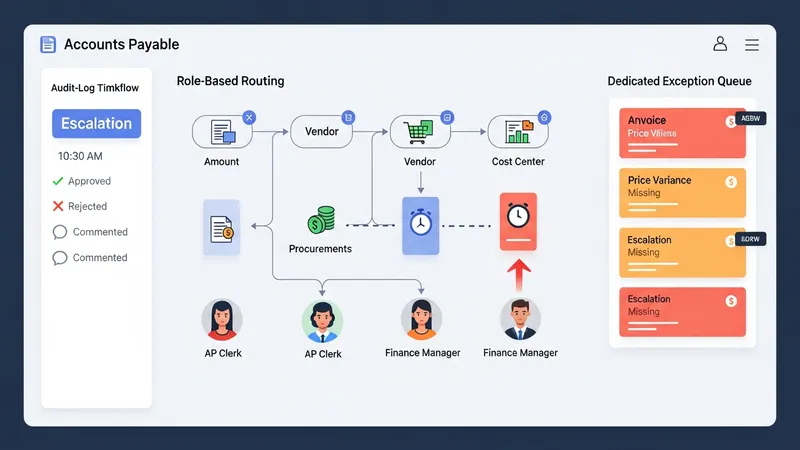
Exception handling addresses invoices that fail validation or matching rules and typically routes these items to a dedicated queue for review. Exceptions may be categorized—such as price variance, missing purchase order, or tax discrepancy—to allow targeted resolution workflows. Some systems present suggested resolutions by referencing related documents or previous decisions, which may accelerate handling. Organizations often monitor exception aging to identify suppliers or processes that contribute to recurring disruptions.
Designing workflows often involves stakeholder mapping so that approvals reflect organizational authority and control points. Segregation of duties is a common requirement: approval authority is separated from payment initiation to reduce risk. Workflow designers may implement approval thresholds that increase oversight for higher-value invoices while keeping lower-value items on streamlined paths. Regular review of workflow performance can identify bottlenecks and inform rule adjustments.
Operational tips often include starting with a limited scope—certain supplier groups or invoice types—to validate workflow logic before wider rollout. Logging and reporting on approval times, rejection reasons, and rework rates provide data for continuous improvement. Training materials that show approvers how to access queues, attach comments, and reassign tasks may reduce user friction and improve cycle times without compromising controls.