
Commercial LED Lights: Key Features And Applications For Business Spaces

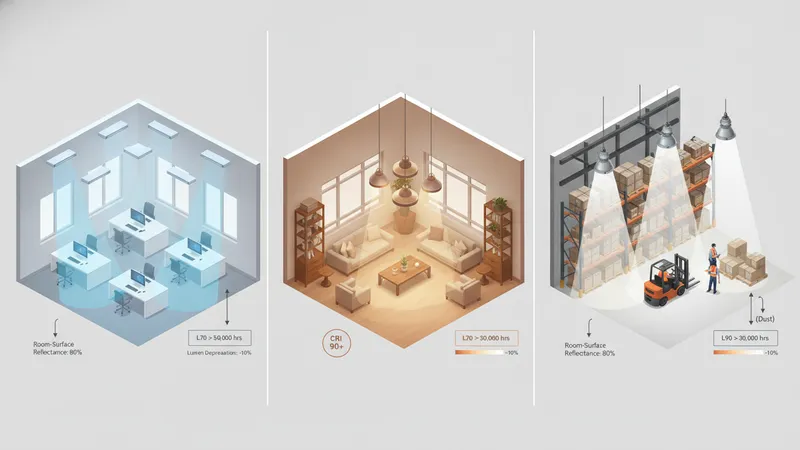
Light output, color temperature, and color rendering considerations for business spaces
Lumen levels and distribution patterns are fundamental when matching luminaires to space tasks. Offices often aim for uniform ambient levels that support visual comfort for computer and paperwork tasks, while warehouses require higher concentrated lumen densities for aisles and picking areas. Designers typically consider maintained illuminance (accounting for fixture depreciation and room surface reflectances) rather than initial lumens alone. Light loss factors such as dirt accumulation and lumen depreciation (L70, L90 metrics) may be used to estimate long-term delivered light levels and schedule maintenance or replacement cycles.
Color temperature choices relate to perceived brightness and occupant preference. Cooler CCTs (e.g., around 4000–5000K) may be used for task-oriented spaces where visual acuity is a priority, whereas warmer CCTs (e.g., 2700–3500K) may be applied in customer-facing areas to create a softer ambiance. These ranges are illustrative; project-specific considerations such as branding, circadian impacts, and existing lighting should be evaluated. Mixing CCTs in a single space can be done deliberately but typically requires careful coordination to avoid visual inconsistency.
Color rendering (CRI and spectral considerations) may affect product presentation in retail and color-critical tasks in industrial processes. Many commercial specifications reference CRI values as part of quality criteria, recognizing that higher CRI does not always equate to a single correct choice for every application. Alternative metrics like TM-30 may provide additional insight into color performance. Photobiological safety classifications and blue-light content are other spectral attributes that can be considered for occupant comfort and regulatory compliance where relevant.
When documenting lighting requirements, professionals often present target illuminances, acceptable CCT ranges, and minimum color-rendering metrics alongside layout diagrams. These specifications allow manufacturers and installers to select compatible fixtures and control strategies. Such documentation can also support life-cycle cost comparisons by combining expected energy use, maintenance intervals, and depreciation assumptions to inform planning without asserting a single optimal solution.