
Commercial LED Lights: Key Features And Applications For Business Spaces

Fixture types and installation requirements for commercial environments
Fixture families introduced earlier—recessed panels, high-bays, and linear systems—each have typical installation patterns and mechanical requirements. Recessed ceiling modules usually require a compatible grid and may include plenum-rated components when installed above drop ceilings. High-bay fixtures often need suspension points, appropriate driver access, and thermal clearance to control case temperatures. Linear systems may be surface-mounted, suspended, or recessed and often require careful alignment for continuous runs. Installation planning typically accounts for mounting hardware, wiring paths, and accessibility for future maintenance.
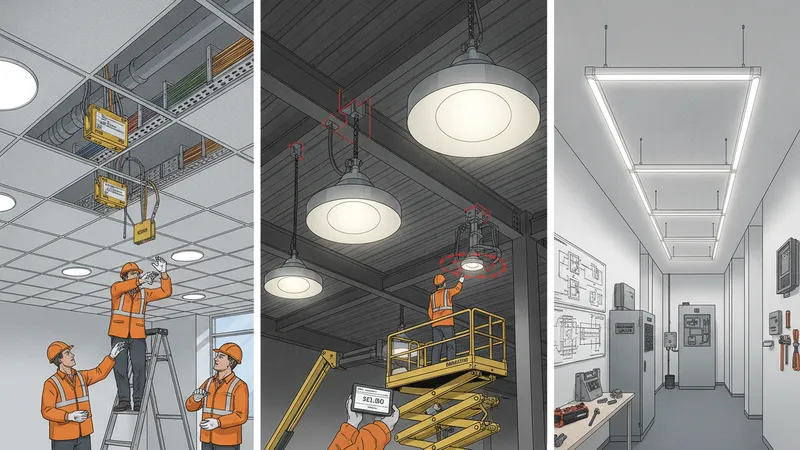
Electrical installation considerations include driver location, conduit runs, junction box placement, and compatibility with dimming or control wiring. Many commercial projects deliberate on centralized driver locations or remote drivers to improve serviceability or thermal performance. Emergency lighting integration, where required by local codes, may mandate separate circuits, battery packs, or central inverters. Installers commonly verify lumen output and operation under intended control schemes during commissioning to ensure the installed system meets design intent.
Thermal management and fixture durability are practical concerns in many business spaces. Heat-sinking design can influence driver lifespan and lumen maintenance; fixtures intended for high ambient temperatures or enclosed housings are often specified accordingly. In humid, dusty, or corrosive environments, IP ratings and material choices (e.g., powder-coated steel, polycarbonate lenses) can affect longevity. For exterior or canopy applications, weather sealing and gasketed enclosures are typical requirements to maintain performance.
Coordination with other trades and building systems is common during installation. Ceiling coordination may affect HVAC diffusers or sprinkler layouts, while structural attachments could require engineered anchors. Lighting placement can interact with acoustic treatments and signage. Early-stage layout reviews and pre-installation mock-ups may help reduce on-site changes and support smoother commissioning without implying a single mandatory process for all projects.